The rousing cheer was a moment unlike any other in the brief life of the ultra-modern headquarters of the IOC.
Hundreds of staff filled three levels of the rings-shaped atrium April 8, sending a wave of applause as Kirsty Coventry entered for the first time as president-elect. When she takes over June 23 she will become only the second IOC president to operate from the headquarters that opened in 2018. The atrium welcome to a new IOC president was the first for the building constructed after Thomas Bach took office in 2013.
The scene was striking for its contrasts and implications for a change in culture at the IOC. Coventry, 41, smiling, in a tailored cream pin striped ensemble. Bach, 71, was clad in the suit and tie uniform of the previous eight men to hold the IOC presidency. That a change is coming to Lausanne is obvious. Of the hundreds of IOC staff welcoming Coventry, most are closer to her age, not Bach’s. A new generation is taking over.
Coventry arrived looking no worse for wear after a 7000 km journey from her home in Zimbabwe with husband Tyrone Seward and daughters six years-old and six months-old. The family will be moving to Lausanne in the months ahead, but it probably won’t be the Lausanne Palace Hotel, habitué of the last three IOC presidents, none of whom had children to tend. The posh Palace may just not be suitable for the growing family.
Coventry says both children will hit the road with her as IOC president.
“My youngest has fit right in. She has travelled with me since she was four weeks old. Being with my husband and daughters is where I find my down time,” she says in an article by Steve Wilson on the IOC website.
Coventry is not only the first woman to head the IOC, but also the first top-tier international sports leader with youngsters at home. It’s a distinction that will likely be part of her image and subject to the curiosity of media throughout her term as chief of the IOC. Already more than 60 interview requests have been lodged with the IOC media office.
Coventry was one of just four IOC members in Lausanne for the April 9 meeting of the executive Board. The remaining 11 members connected virtually. They okayed the sports program for the 2028 Olympics and signed the host contract for winter 2030 and the French Alps. No word on any remarks that might have been made by Coventry, who sat to Bach’s right. These meetings are held in camera.
The new IOC leader will be in Lausanne until next week when she’ll head back to Zimbabwe. It’s probably not the last before she takes office June 23. In the meantime it’s a series of meetings with IOC staff, sponsors, broadcasters and beyond with Bach guiding the transfer. Bach and Coventry met virtually tnis week with the EB as well as staff in Madrid at Olympic Broadcasting Services. Bach introduced her to a meeting of European sports leaders and more such events are ahead.
Changes Coming in Lausanne
Besides finding domicile in Lausanne, Coventry also will be looking for a few good men and women to fill posts she currently holds on commissions.
A new chair for the coordination commission handling the 2026 Youth Olympic Games in Dakar will be needed. Coventry has led the panel since 2018; the position seems likely for another member from Africa. These games are also seen as an early test of Africa’s ability to host an Olympic Games, perhaps chosen during the Coventry presidency. She’ll also need to replace herself as chair of the IOC Commission for the 2032 Summer Games in Brisbane. It will be a closely watched appointment: whoever gets this nod could end up on the short list of possible Coventry successors in the next decade.
Coventry is also a member of commissions for Olympic Solidarity, Public Affairs and Corporate Communications and Finance. It will be up to her to choose replacements as well as naming the membership of all of the three dozen commissions. Together they have some 300+ members from inside and outside the IOC.
A seat on the 15-member Executive Board opens when Coventry takes office. But it’s not hers to fill. The seat will remain unfilled until the next IOC Session in February 2026 when the full IOC can vote on a replacement.
The Milan Session next year also will elect the first new IOC members of the Coventry era. The IOC president has considerable sway over who is nominated by the commission led by Princess Anne. The EB formally okays the list for what is usually a pro forma vote at the IOC Session. How many seats will be filled isn’t certain yet; about a half dozen members are leaving in 2025 due to age 70 mandatory retirement or loss of status as an international federation or national Olympic committee leader.
Coventry may be just the person to bring the IOC membership to a 50/50 gender split after decades of trying. Of the 111 current members 57% are male, 43% female. Over the next 12 years, if she wins a four year term extension, Coventry could see 70 or more new IOC members take the oath to replace those leaving.
Significant changes to the staff at the IOC are not expected when Coventry comes to power. With the next Winter Olympics coming just seven months after taking office, continuity is a plus. But as her mandate progresses, changes are inevitable, and she already has some key hires to oversee.
Top of the list would be a sports director. Kit McConnell, a 20-year IOC veteran, will return to his native Australia to be chief of sport for Brisbane 2032.
Jacqueline Barrett, who’s been at the IOC even longer, will be leaving as well. As the director of future host cities she has managed the bidding process for the Olympics since 1992. The next person to hold that job is headed to a hot seat for sure.
Every Olympics, summer and winter, has been selected or designated through 2038, except for one. The 2036 Summer Games are still open with a crowd of well-heeled contenders knocking on the door of the IOC. India is pushing for those Games with the backing of IOC member Nita Ambani, one of the world’s wealthiest women. Qatar may try again or perhaps Saudi Arabia, both with IOC members who have international heft.
Those ambitions may have to contend with the aspirations of the first IOC president from Africa. The Zimbabwean Olympian about to become the country’s best known international figure is expected to be a powerful advocate to bring the first Olympics to Africa. With Games being chosen by the IOC as long as 10 years or more ahead of time, Coventry will soon be pressed on how to help deliver an Olympics to Africa – while maintaining a fair process to choose hosts for 2036 and beyond.
A contributor to U.S. cable channel Fox News with zero experience in the field of sport doping is nominated to lead the White House Office of National Drug Control Policy.
The ONDCP was created in 1989 to tackle drug addiction and abuse. The portfolio has since expanded to include U.S. representation at the World Anti-Doping Agency, the international body managing the fight against performance enhancing drugs.
Sara Carter, an investigative journalist who has reported for Fox News, was nominated March 28 to the post by U.S. President Donald Trump.
“From Afghanistan to our Border, Sarah’s relentless pursuit of Justice, especially in tackling the Fentanyl and Opioid Crisis, has exposed terrorists, drug lords, and sex traffickers. As our next Drug Czar, Sara will lead the charge to protect our Nation, and save our children from the scourge of drugs,” said Trump in a posting on his Truth Social website that announced the appointment. The appellation of “Drug Czar” hales to the first ONDCP director, William Bennett, who served under President George H.W. Bush from 1989 to 1991. Since then the nickname has stuck to the dozen or so successors.
Carter’s professional career as described on her website saracarter.com includes no experience in sports doping, government or administration of large organizations.
The ONDSP oversees a $43 billion budget and coordinates the work of 19 other federal agencies “addressing addiction and the overdose epidemic” says a release from the administration of Joseph Biden.
Dr. Rahul Gupta served as the previous ONDCP director. A physician, he was state health chief for West Virginia prior to heading to Washington. Others to hold the post have included public health experts, former cabinet members, a retired U.S. Army General, ex-big city mayors and a former governor of Florida.
Under the first Trump administration the ONDCP directorship was a revolving door. There were three interim directors, including a 24-year-old Trump campaign worker, until a permanent director was confirmed by the U.S. Senate for the final months of the Trump presidency. Carter will also need to be confirmed to take charge of the office. There is no schedule set yet for Carter’s Senate review.
“It is truly an honor to serve President Donald J. Trump and be part of an administration committed to putting America first,” says Carter in a post on X.
“I pledge to work tirelessly every day to identify the challenges we face and find the solutions that will Make America Safe Again, freeing us from the grip of deadly substances like fentanyl, heroin, opioids, and other dangerous drugs. I am ready to serve at the pleasure of the President, bringing with me years of experience in investigating cartels, terrorists, human and drug traffickers,” Carter says, not mentioning any sport doping angle to the job.
Also waiting Senate confirmation is the nomination of Monica Crowley as under Secretary of State responsible for protocol. That job entails working with organizers of the 2026 World Cup to be held in the U.S. , Mexico and Canada and the 2028 Summer Olympics in Los Angeles. Like Carter, Crowley’s background includes reporting and anchoring for Fox News.
Attempts to reach Carter this week for comment were not successful.
The task ahead for the next ONDCP director includes healing the strained relationship between the U.S. and WADA. Ever since Russia was caught in a massive doping scheme after the 2014 Winter Games in Sochi, critics of the agency have bloomed. New strains have emerged over the last year with revelations that 23 Chinese swimmers with adverse findings of doping were cleared to compete at the 2020 Tokyo Olympics.
Outraged members of the U.S. Senate authorized Gupta to withhold payment of dues to WADA, $3.5 million annually, until the findings were reversed. That hasn’t happened. Nonetheless, Gupta eventually okayed payment before leaving office in December. Current dues are required for a country to hold seats in the WADA leadership; the U.S. has customarily been one of the 32 members of the WADA foundation board.
Gupta maintained that the U.S. was seeking assurance its contribution, the biggest among the 200+ nations covered by WADA, delivered results.
“WADA must take concrete actions to restore trust in the world anti-doping system and provide athletes the full confidence they deserve. When U.S. taxpayer dollars are allocated, we must ensure full accountability and it is our responsibility to ensure those funds are used appropriately,” Gupta was quoted by the Associated Press in 2024.
On the flip side, WADA, as well as some international sport leaders, remain unhappy with the so-called Rodchenkov Act. That law enacted during the first Trump administration, gives U.S. law enforcement the power to prosecute individuals around the world involved with doping conspiracy. Sport leaders concerned about the law worry about the long reach of its provisions, saying it could unfairly target officials or athletes at the upcoming 2028 Games in Los Angeles and the 2034 Winter Games in Salt Lake City . The name came from the Russian chemist who masterminded the Russian scheme and then fled to the U.S. to expose the state run doping charade.
Travis Tygart, the outspoken head of the U.S. Anti-Doping Agency, has been a critic of WADA through the years. He says with two Olympics on the horizon for the U.S. setting the stage is vital for the athletes.
“Now is the time to get WADA right to ensure these competitions on U.S. soil are clean, safe, and a pageantry of fair competition in which we can all have faith and confidence,” says Tygart.
Despite the difficulties between the U.S. and WADA, controversies are not expected to affect the participation of U.S. athletes at the World Cup or Olympics.
The upcoming confirmation hearing for Carter, still to be scheduled, is likely to focus on the drug addiction aspects of the ONDCP, the battle against fentanyl. Sports doping did not come up in the pro forma hearing for Gupta in 2021. This time, however, in a moment when alliances and norms are being uprooted by a new administration, perhaps Carter might be quizzed about the doping issues under her remit. Her answers may tell whether the U.S. plans continue the sizeable roll it has played in the worldwide fight against doping in sport.
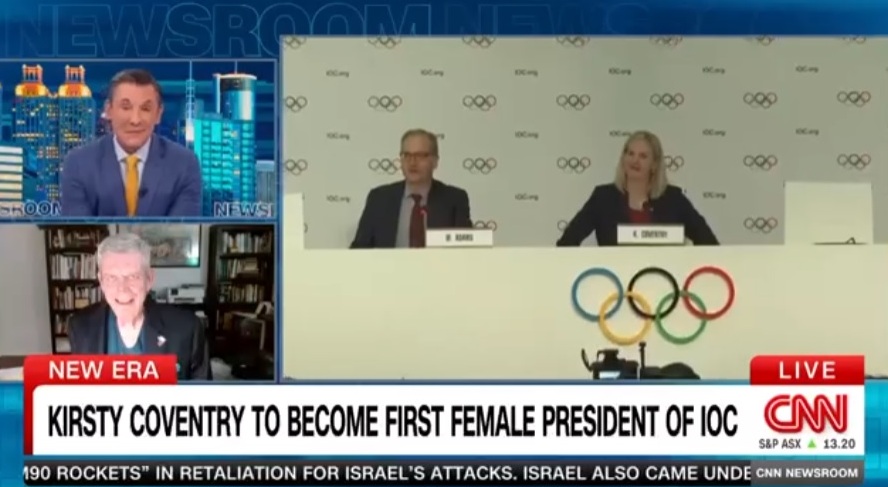
The International Olympic Committee has its first female president since its founding in 1894. Zimbabwe Olympic gold medalist Kirsty Coventry triumphed over a field of six other candidates, all men, in the first round of voting at the IOC’s session in Greece. While she was a favorite at least two or three rounds of voting were expected for one candidate to win a majority of the votes, 48 in this case.
Coventry is the first IOC president from Africa and the youngest in the post in the 130 years of IOC history. She will be the 10th IOC president, succeeding Thomas Bach who steps down in June after 12 years in office.
In her campaign message to IOC members Coventry pledged to bring her background as a recent Olympian to focus on the needs of athletes who make up the heart of the Olympic Games.
Pressed by reporters after the vote as to her immediate plans Coventry says she wants to bring together the other candidates to solicit their ideas and those of other IOC members before charting a course of action.
Her first round victory was decisive. Winning 49 votes to 28 for her nearest rival, Juan Antonio Samaranch of Spain, son of the IOC president who served from 1980 to 2001. Sebastian Coe, president of World Athletics, garnered just eight votes. Cycling Federation president David Lappartient and gymnastics Federation president Morinari Watanabe both took four votes each. Prince Feisal al Hussein of Jordan and Sweden’s Johan Eliasch received two votes.
Coventry was seen as a protégé of Bach who came to office the same year Coventry took a seat as an IOC member in 2013.
Kirsty Coventry is applauded by outgoing IOC President Thomas Bach.
Coventry now begins a three month transition working alongside Bach. Changes will likely come for some staff at the IOC headquarters in Lausanne as Coventry prepares for the next eight years of her term.
She also will be making adjustments to her life. . She says she will be moving to Lausanne from her home in Zimbabwe. But she did not indicate whether she would live in the apartment on the top floor of the Lausanne Palace Hotel which has been the home for the past three IOC presidents. For the first time this IOC president comes to office with a young family that includes a five-month-old daughter and another seven years old. Coventry says she has strong support from family members that will enable her to spend the time needed as IOC president.
Despite the remote location of the IOC Session in southwestern Greece, 300km from Athens, about 100 media from around the globe made the trek. Available for public consumption on YouTube, more than 3,000 devices were on line for the announcement according to the streaming service.
Asked about how she would deal with U.S. President Donald Trump ahead of the 2028 Los Angeles Olympics on issues that might arise, Coventry replied that Trump “it is a huge fan of sport “and she’s confident he will make sure LA 28 has what it needs. She also noted that “I have been dealing with difficult men in high positions since I was 20”.
Written by Ed Hula
Contributions from Mara Xenou and Brian Pinelli in Costa Navarino, Greece
On the eve of the vote to pick his successor, IOC President Thomas Bach was hailed by colleagues for 12 years of service that they say changed the Olympic Movement.
The hour-long genuflection came after a succession of reports on IOC matters like finance, the Paris Olympics and Bach’s signature Olympic Agenda reform package. There were no surprises, no untoward business, no waves to wobble the boat on a day meant to laud Bach.
The IOC Session in Pyros, Greece on Wednesday.
The tribute began with a nearly 30-minute video produced by Olympic Broadcasting Services covering Bach’s presidential tenure. It was chock full of plaudits from athletes, Nobel laureates, the chair of U.S. rightsholder Comcast Brian Thompson, Alibaba’s Jack Ma, French President Emmanuel Macron and Pierre de Coubertin biographer George Hirthler .
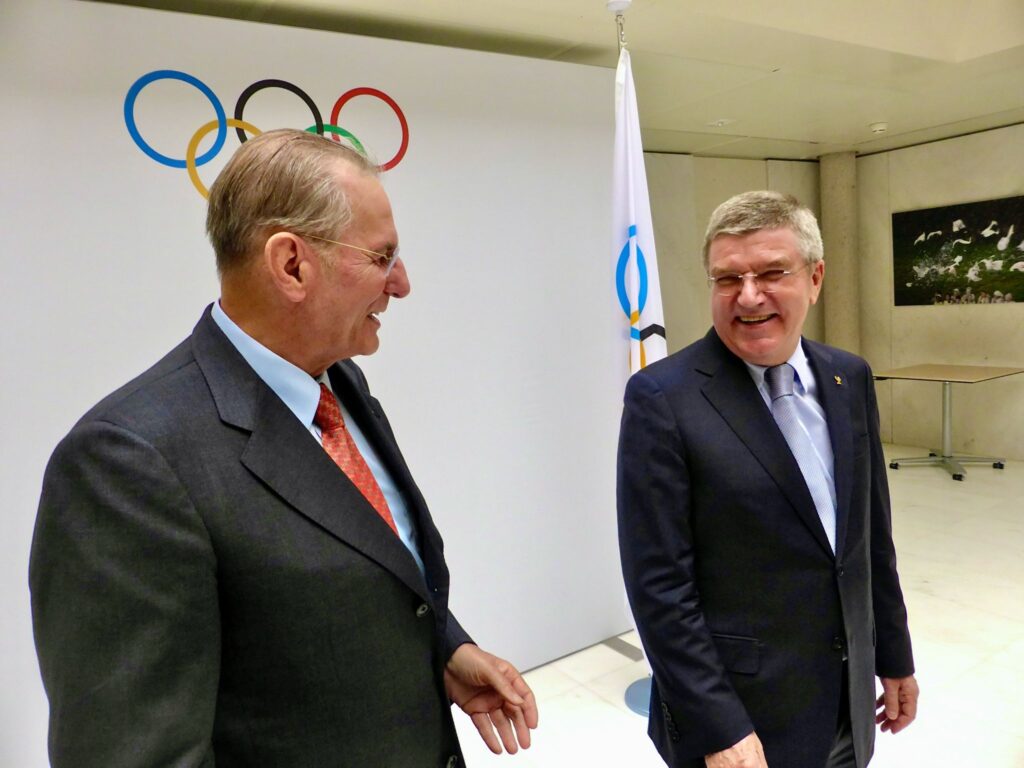
When the lights came back on, IOC members launched into a long string of bon mots, but not before they confirmed Bach as honorary president for life. Bach, 73, can serve until age 80 as an IOC member, but plans to resign from that seat when he steps down as president on June 23. He will be the only living ex-president of the IOC. His predecessor, Jacques Rogge, died in 2020.
Bach in 2014 with his predecesor Jacques Rogge. (Brian Pinelli)
Bach was visibly emotional from the outpouring of affection, fighting back tears, his voice quivering as he declared that his success “is not the work of one man. We should never forget that this Olympic movement is bigger than ourselves.”
“You see a happy man. I have given what I could give,” he told the session,
The timing of the farewell for Bach on this opening day clears the deck for the attention coming Thursday for the election of his successor. IOC members are keeping their preferences private, resulting in wild speculation. Predictions that Kirsty Coventry of Zimbabwe will win on the first ballot are matched by guesses that it is Spain’s Juan Antonio Samaranch who wins outright. Sebastian Coe, despite his Olympic pedigree, won’t win say some handicappers.
Other candidates aren’t given much of a chance. Jordanian Prince Feisal Al Hussein, cycling federation chief David Lappartient, ski federation president Johan Eliasch and Morinari Watanabe, the president of the gymnastics federation round out the field. It’s the biggest group of candidates ever for the IOC presidency. The secret ballot is Thursday afternoon and will follow the election for three open seats on the Executive Board.
Baron Pierre-Olivier Beckers-Vieujant of Belgium is the only candidate for the vice president seat held by Nichole Hoevertsz from Aruba.
There are two regular seats open on the board. Norwegian Kristin Kloster and Emma Terho from Finland each hold a seat with hopes of reelection. Challengers are Spyros Caparalos from Greece, Chilean Nevin Ilic and Romanian Octavian Morariu.
Written by Ed Hula
With contributions from Coasta Navarino by Mara Xenou and Brian Pinelli
Invoking the gods of ancient Greece and the spirit of Pierre de Coubertin, IOC President Thomas Bach opened an IOC Session that will set the course of the Olympics for years to come.
“Pierre de Coubertin once said: “The Olympic Games are a pilgrimage to the past and an act of faith in the future.”
“This is exactly what this IOC Session is about. A sacred pilgrimage to our ancient past. An homage to our modern origins and to our founder. And a manifestation of our faith in the future, when we will elect a new President.
“I am sure that – from their Olympic heights – the ancient Greek gods and Pierre de Coubertin are following us very closely. They will be pleased to see that we have returned to our Greek roots at this important point in our history. Here – even if for only a fleeting moment – our past, our present and our future are aligning like stars in a constellation,” said Bach to the nearly 100 fellow IOC members in Ancient Olympia to mark the open of the 144th IOC Session. On Thursday the members will elect a new president from a group of seven candidates.
The gathering in Olympia Tuesday was symbolic. While an exact figure is not available yet, the number of IOC members in Olympia is believed to be the largest ever for a single event. The rest of the IOC session takes place 90km south along the Ionian seacoast at the Romanos Resort. It’s the closest property to Olympia with sufficient room and meeting space to hold a 21st century session drawing 500+ persons.
Plans for an IOC session in Greece have been underway for some time. First set for 2001, the covid pandemic forced the IOC to meet virtually instead, shifting the Greece session to 2025.
The simple ceremony under a marquee overlooking the first Olympic stadium featured traditional and modern dance performances, capped with the now classic Zorba the Greek music.
Ignoring the unwelcoming windy and rainy weather, Greek President Konstantinos Tasoulas welcomed the IOC to come back to Greece on a regular basis. In his speech at the ceremony Tasoulas called for the IOC to always hold its presidential election in Olympia. While the sentiment may be appealing, the infrastructure of Olympia cannot handle the crush of an IOC meeting. Even the resort where this week’s session will be held has limitations. No comment yet from IOC meeting planners.
The IOC Session continues Wednesday at 0900 EET.
Written by Ed Hula
With contributions from Coasta Navarino by Mara Xenou and Brian Pinelli
The long farewell of IOC President Thomas Bach is underway as he convenes his final session after 12 years at the helm of the world’s leading sport body. His successor to be chosen in three days will come from a field of seven contenders who have all arrived in Costa Navarino, Greece.
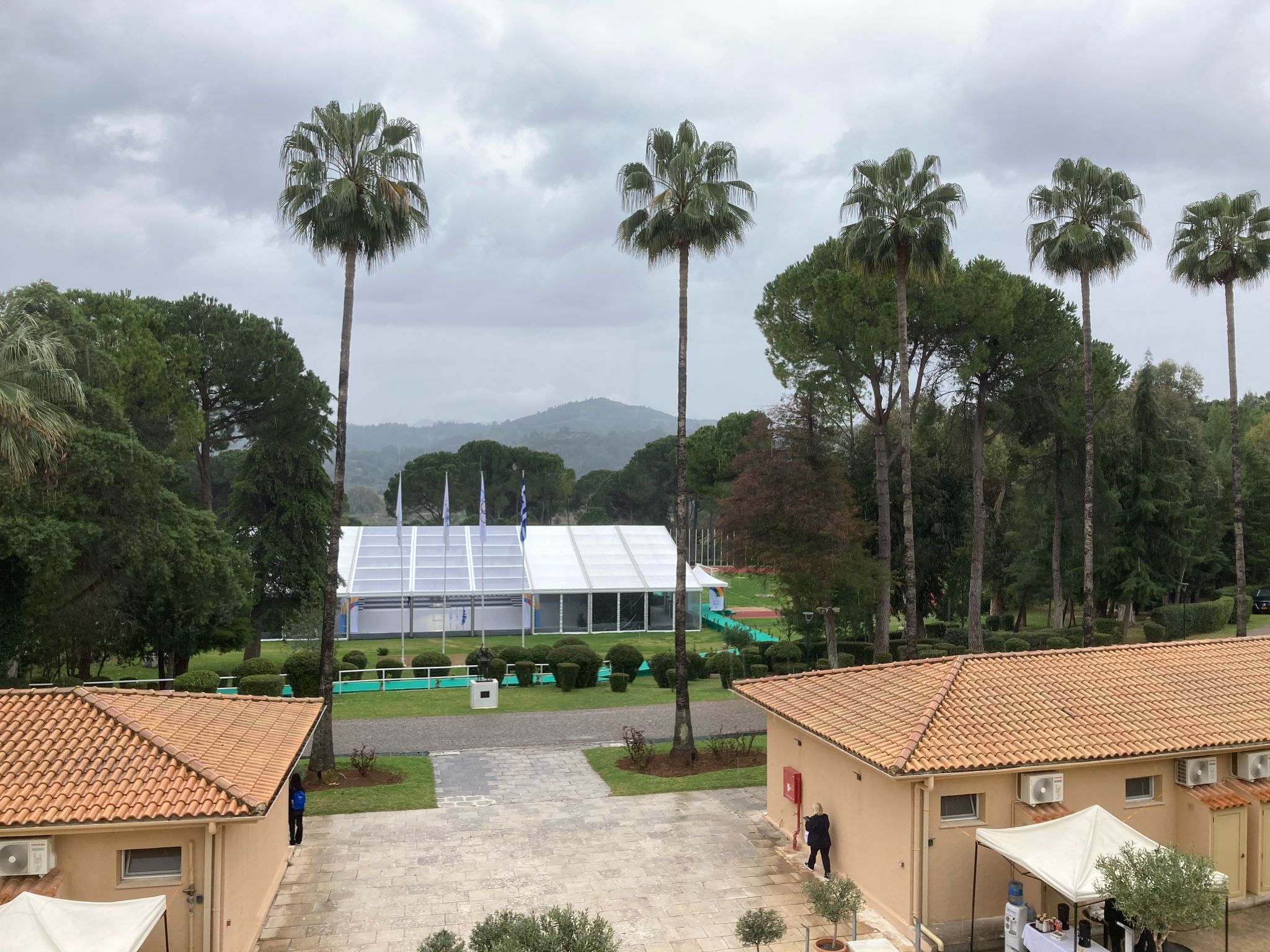
The meetings take place at the Romanos Resort, 300 km southwest of Athens on the shoreline of the Ionian Sea. By car, the journey takes three and a half hours. That creates a huge logistical challenge for the hundreds heading to the meeting, most after long airplane journeys from points around the globe. This is the off-season in sunny Greece, and the proof can be found in the weather: breezy conditions with lows of 6c and highs near 16c are forecast.
The salubrious scene at Costa Navarino
Tougher to predict is the outcome of the vote for a new president on Thursday. While the seven candidates have held media interviews over the past few months, the rules governing the race limit any comparisons, endorsements, debate or campaigning except for one-to-one contact with members. The only speeches to the members came January 20 when all gathered in Lausanne for presentations held behind closed doors. None will be heard in Greece ahead of the March 20 vote.
Three candidates are believed to command the most attention from the 100 or so members expected to attend the session. Two of the favorites — Kirsty Coventry of Zimbabwe and Juan Antonio Samaranch of Spain — are members of the IOC Executive Board, which met Monday on the eve of the session open. Another of the seven contenders, Jordanian Prince Feisal Al Hussein, is also a board member but is considered a long shot.
World Athletics president Sebastian Coe may have the longest Olympic resume as a gold medalist and chief of the London 2012 Olympics. That celebrity has made him one of the three favorites. But Coventry is regarded as the favorite of Bach and a protégée of his presidency. She became an IOC member at the same 2013 IOC session Bach took office. Her election would be of great note globally as the first woman to be elected IOC president.
Asked at a press conference Monday, Bach did not directly dispel any links to Coventry’s aspirations. But his terse summation of where he sees the IOC going perhaps speaks volumes. “New times need new leaders,” he said.
It would be notable if Samaranch were elected. He would follow his father, president from 1980 to 2001. Nonetheless, Samaranch has eschewed mentioning his father, instead emphasizing his own 24 years of experience on the IOC. Just 17 of the 109 current IOC members served while the senior Samaranch was president.
Other candidates include cycling federation chief David Lappartient, ski federation president Johan Eliasch and Morinari Watanabe, the president of the gymnastics federation. However, none of the three, along with Coe, have yet to serve on the Executive Board. Of the nine previous presidents, all have had stints on the EB.
The 15-member EB met Monday in Greece in a meeting well short of the normal full day. The topline from the meeting would be the recommendation of the board that would keep boxing remain on the program for Los Angeles in 2028. IOC members will be asked to approve a new federation for the sport. World Boxing was formed two years ago to replace the International Boxing Association, which was officially defrocked in 2024 over issues involving governance, finance and ill will that grew from the suspension of IBA in 2019.
IOC members will journey to Ancient Olympia for the ceremonial open of the 144th session on Tuesday. It promises to be a long day, with two hours of driving each way from Costa Navarino. The ceremony is set for 3pm in the ruins of the ancient Games. It will be the biggest gathering ever of IOC members at the site. It will also be the site of Bach’s final speech opening an IOC session.
He will stay in office until June 23, when his successor will take the oath. Speaking at a press conference after the EB meeting, Bach said the three-month transition will be better for the new chief. When he was elected in 2013 Bach says the transfer was immediate from Jacques Rogge.
“I did not appreciate it,” he sourly noted Monday. He says he would have welcomed time to meet staff and other principals of the IOC. While it is not specified in the Olympic Charter, the new president customarily takes over soon after election. Bach says he has the backing of the EB, and noted that transitions at the top of large businesses or governments are common practice.
Written by Ed Hula
With contributions from Coasta Navarino by Mara Xenou and Brian Pinelli
The race to become the next president of the International Olympic Committee remains a muddled field of seven following a critical test of electability. After presentations just days ago to about 100 of their fellow IOC members and a small press contingent, it seems clear that at least two candidates may be better served by dropping out.
Thomas Bach will leave the IOC presidency in June.
The January 30 meeting at Olympic House in Lausanne was the only chance for the candidates to present their plans to assembled IOC members. In March they will gather again in Greece to vote on a successor to Thomas Bach. The race began in September and has drawn a record number of candidates.
Tightly regulated with rules prohibiting endorsements, deal-making and nearly any kind of promotion, the campaign is the first for an IOC chief in 12 years.
Prince Feisal Al Hussein of Jordan, David Lappartient of France, Johan Eliasch of the U.K., Juan Antonio Samaranch of Spain, Kirsty Coventry of Zimbabwe, Sebastian Coe of the U.K. and Morinari Watanabe of Japan are the candidates who face the challenge of seeking support from their IOC colleagues given the strict rules of the campaign.
The presentations were held behind closed doors, limited to 15 minutes of PowerPoint delivery. No questions allowed.
About 30 members of the press were accredited for the Lausanne event.
Question time Thursday fell to the 30 members of the media accredited for the meeting. Each candidate had 10 minutes, in the same protocol order drawn last year in the early stage of this path to the presidency.
Given the weight of issues facing the IOC and its next president, 10 minutes with the media and 15 with the IOC members seems stingy. Indeed, by the time Watanabe ended the series of press briefings there were the proverbial more questions than answers. Doubtless IOC members may have felt the same way.
More needed to be said about the IOC split with Russia, the changing world of Olympic telecasting, the need to bring youth to the Olympics, the integrity of women’s sport, making sure all is right with Olympic Games on the horizon – and that’s just the beginning of a long list of challenges facing both the next IOC president and journalists who follow the Olympics to report.
Some conclusions can be drawn from this week’s presentations: at least two of the candidates should drop out.
Johan Eliasch and Morinari Watanabe are both accomplished individuals but unlikely to win more than a handful of votes on March 20.
Johan Iliasch was born in Sweden and lives in the UK.
Eliasch is a successful business person and president of FIS, the international federation for ski and snowboard. In his manifesto and comments to the press he clearly understands the need for the IOC to “get ahead of the curve” of challenges it faces.
With just seven months on the IOC, he is known to only a few members and seems unlikely to pickup many votes. Regardless, Eliasch is earnest about the need for IOC change and has the business acumen to be of great value in the years ahead as a member.
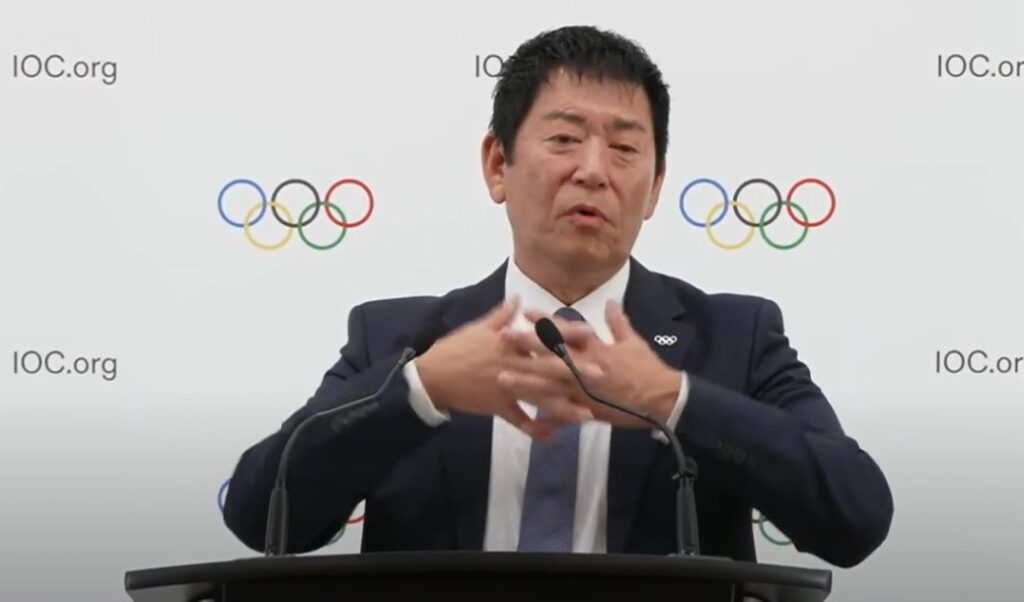
Gymnastics Federation chief and IOC member in Japan Morinari Watanabe.
Watanabe, the head of FIG, the international gymnastics federation, has built his campaign on a radical reinvention of the Olympics that would spread events across five continents at the same time. He would push for a reorganized IOC with upper and lower houses of governance. Neither notion has any support among IOC members. Watanabe could be subject to some embarrassment depending on how many ballots he secures.
These hypothetical departures from the race probably won’t move large blocks of votes. But it will turn the focus on the five remaining contenders: Feisal, Lappartient, Coventry, Samaranch and Coe.
While Eliasch told reporters “this is not a popularity contest”, IOC members are likely to consider the personalities of each of the candidates. Along with their know-how and plans of action, the candidates may also be measured by the gravitas and charisma they will bring to the job.
Given the outsized role of the IOC president as the voice of the organization worldwide, it’s worth considering. Meeting heads of state, opening and closing Olympic Games, charming Olympic sponsors and rights-holding broadcasters as well as connecting with Olympic athletes are all requirements of the 21st Century IOC president.
Prince Feisal of Jordan joined the IOC in 2010.
Feisal has low-key style and may be overlooked for better-known rivals as a result. But his bearing and grooming as a member of the Jordanian Royal family has certainly imbued him with the gravitas needed for the IOC president. He has become an IOC expert on refugees and boosting women’s sport.
David Lappartient at the media briefing.
Lappartient is a fast rising IOC member. He’s president of both the French Olympic Committee and the international cycling federation. In the press briefing he came across as earnest and affable; he was the only candidate to speak in French and English. If he is not successful, Lappartient, 52, could run again when the presidency next reopens without complications over the age 70 retirement rule, something all the candidates say should be open to change.
Juan Antonio Samaranch said the IOC should regard media as an ally not an enemy.
After 25 years on the IOC, Samaranch should have the deepest storehouse of knowledge among his rivals. While he may not be the most charismatic of the bunch, he clearly has developed a sense of gravitas from his work on the IOC and perhaps observing his namesake. He had plenty of time to observe: Samaranch was 21 when his father began his 21 year tenure as IOC president.
Kirsty Coventry won two gold medals in swimming for Zimbabwe.
Coventry came across in the press briefing as someone who will be a strong bridge between the IOC and athletes. In her 12 years on the IOC she has tackled increasing responsibilities that give her a high profile, whether speaking to the U.N. or overseeing preparations for the 2032 Olympics in Brisbane.
Sebastian Coe speaking to the press in Lausanne.
Coe is clearly the member with star power among the field of candidates. Olympic champion, head of the London Olympics, and now president of World Athletics, coat has lived his life in the spotlight. He sounded at ease and confident in his meeting with the media, just the latest of countless press conferences he’s seen in 45 years in sport.
The IOC Session in Lausanne Jan.30.
The seven candidates joined their colleagues for lunch and the conclusion of their one day session Lausanne last week. The only piece of business was to award the 2029 Winter Youth Olympics to the Italian Alps. It was the only choice. Things will be much more complicated on March 20 as IOC members face an array of choices that will shape the next generation of Olympic Games.
Ed Hula has covered three IOC presidential elections across 25 years on the Olympics beat.
Intrigue returns to the IOC. International Olympic Committee President Thomas Bach steps down in June as he reaches the 12-year term limit. Seven IOC members are running to succeed him. But there is not yet an obvious favorite in the race to be decided in late March.
Olympic House in Lausanne
Prince Feisal Al Hussein, David Lappartient, Johan Eliasch, Juan Antonio Samaranch, Kirsty Coventry, Sebastian Coe and Morinari Watanabe are the names to follow . It’s the biggest field of contenders since the IOC began in 1894. Their names are listed in the protocol order, which was determined in a random draw late last year.
In just a few days they will appear in Lausanne to make the only pitch to their colleagues allowed ahead of the March vote in Greece. Under the hyper-regulated rules of the IOC, the 15-minute presentations will be held in camera. Telephones and other recording devices will be checked at the door. No Q&A is allowed. Presentations are limited to power point only, meaning no video. Candidates will each have a room near the meeting and will stay quarantined until their time to speak. At the end, the seven will make 10-minute appearances for the select group of media covering the event.
The rules are meant to present a level playing field: no public promotion, no debating or comparisons allowed. Endorsements also are banned.
Travel to meet with individual IOC members is discouraged and must be cleared with the IOC ethics officer 10 days ahead of travel. Virtual contact is encouraged. Third-party promotion is banned and social networking campaigns are also forbidden.
Feeding the intrigue of this election are some serious issues confronting the next IOC president:
Recognizing an ostracized Russia
challenges to anti-doping
integrity of women sports
light-speed technology changes
the growth of esports
declines for mainstay Olympic sports
and a shifting landscape for worldwide sponsors.
Despite those challenges and more, this election has drawn a well-spoken and accomplished field of contenders. The manifestos they submitted to the IOC are packed with ideas that speak to the future of the Olympics. Ranging from five to 42 pages in length, all have a polished look that should play well in Lausanne. There’s a link to the manifestos of each candidate, in the order of appearance in Lausanne Jan. 30.
Prince Feisal Al Hussein is brother of the king of Jordan and would be the first IOC president from Asia. He is 62 and can serve until 2037 with an age extension. His 20-page manifesto is titled “Fulfilling Sport’s Global Potential”. He calls for more engagement of IOC members in decision-making, a common point in all seven proposals from the candidates.Feisal would like to plan for the IOC future with an Olympic Agenda 2036 program modeled after Bach’s Olympic Agenda 2020. Greater flexibility in staging the Olympics and a rethink of the TOP sponsorship program would be part of the new agenda, he says. He also would push the IOC retirement age to 75.
The prince sees the role of the IOC as a force for peace, drawing on the experience of his NGO Generations for Peace. On the IOC he is a champion of gender equity.
“The current rise in interest in women’s sport was preceded by decades of work in the Olympic Movement to create a space where female athletes could excel, and I fully intend to build on this and ensure the IOC acts as a beacon for a global move towards gender equality over the next decade,” he writes in the manifesto.
David Lappartient, 52, is part of the new generation of sports leaders on the IOC. He is president of the French national Olympic committee as well as international cycling federation UCI.
Soon after his arrival at the IOC in 2022, the backbencher was handed the IOC portfolio regarding Esports. Since then he has worked to put together an Olympic Esport event that is supposed to debut this year in Saudi Arabia, which would host future editions as well. He calls this new addition to the calendar “a watershed moment” for the IOC. As president of the French NOC, he was able to share in the glow of a successful Paris Olympics and raise his profile among the IOC members.
Lappartient’s 24-page manifesto covers the range of issues ahead for the IOC. He is calling for the formation of an Olympic Agenda 2036 program that he says would prepare the organization to deal with the force of changes that he says are coming.
Lappartient is the only one to recognize the challenge facing the Olympics from what he calls a rise against globalization. He says he is the right person to address this issue.
“Major international sporting events and international organisations such as the IOC are associated with globalisation. As a result, local movements against the organisation of major events can join forces, as with the NOlympics Anywhere network. Not content with opposing the Olympic Games in their respective cities, they strive to ban the IOC outright. Fortunately, these groups have no meaningful support, but that does not mean that we should not take them into account in our considerations and risk assessments. The road will get bumpy in the next few years, so, as you can imagine, we need to rethink our overall approach. Having an IOC President and leaders used to exercising power in a tense climate will be essential,” he says in the manifesto.
As an individual member of the IOC and his youth, Lappartient can serve a full 12 years. His retirement year is 2043.
Swedish-born U.K. businessman Johan Eliasch is president of international ski federation FIS and would be the first IOC president from a winter federation. Elected to the IOC by virtue of his FIS leadership, Eliasch is a true backbencher who joined the IOC just seven months ago. Eliasch has a long career in business and with philanthropic organizations. He was CEO of sports gear manufacturer Head. In his 24-page manifesto he asserts that his business background makes him fit to be an IOC president.
“We need highly experienced leadership, gained over decades at the sharp end of sports administration, business, politics and philanthropic endeavours. Our next president must have steered a large organisation and managed change within it; faced a blizzard of decisions to make every day; and not only made decisions but overseen their delivery too,” he writes. He adds that he may be a novice at the IOC but he is deeply experienced in world sport. The Eliasch manifesto is a dazzling array of graphic arts that will be part of the powerpoint he’ll ,ale on June 30, his first elocution to the IOC he joined just seven months ago.
Eliasch, 63, would need a change in membership status if he won. He holds the seat because of his FIS presidency which he would have to relinquish if elected to IOC president. The IOC Session would need to re-nominate him as an individual member, as well as grant him a four year extension of his term when he turns 70. The membership gymnastics are all pro forma, the same circumstances facing Coe and Watanabe. Eliasch could serve until 2036.
The senior candidate — Juan Antonio Samaranch — has been a member for 24 years. That experience, he says, is one reason he should be considered for the presidency held by his late father from 1980 to 2001. Samaranch Sr is not mentioned in the 42- page manifesto, which is replete with ideas and three dozen action proposals. To generate new revenue, for example, Samaranch believes the facilities of Olympic Broadcasting Services are an IOC asset that can be profitably employed by sport events around the world.
Samaranch begins his manifesto saying he welcomes more engagement with members and the IOC leadership.
“From our conversations, it is clear that Members need a stronger voice in shaping our future—a sentiment I fully support. The IOC’s greatest strength lies not in the narrow perspectives of a select few but in the collective wisdom of its Members. To fulfill our mission, Members must be fully empowered to express their opinions and insights, and we must ensure we have the resources and tools needed to promote and uphold the values of Olympism.
“We must also revisit the age limit to ensure we are not arbitrarily losing the benefits of experience and knowledge,” he said, without specifying a new limit.
Kirsty Coventry has been on a steady rise since becoming a member in 2013, a result of her election to the IOC Athletes Commission. She was chair of the commission for the last half of her term that included four years as a member of the Executive Board. Intent on keeping her on the IOC, Bach made sure she was approved for an individual membership that allows her to serve until age 70, some 23 years to go. Coventry is an Olympic champion swimmer and is the minister for sport in Zimbabwe.
Her IOC portfolio includes chair of the coordination commissions for the 2032 Games in Brisbane and the 2026 Youth Olympic Games in Dakar. She has a seat on the exclusive Finance Commission. Believed by many to be a favorite of the IOC president, Bach has stayed silent, in compliance with the campaign rules. Coventry might appreciate the limits on travel for candidates. She’s now caring for a newborn since last month as well as another youngster. She obviously is headed to Lausanne this month and Greece in March.
Coventry would be the first woman to become IOC president after nine men preceding. But she is not the first to try. That distinction goes to Anita Defrantz of the U.S who ran in a field with four men in the2001 election won by Jacques Rogge. She was eliminated in the first round with nine votes. It should be noted that in 2001 there were 12 women on the IOC. In 2025 there are 48, nearly quadruple. The possibilty of becoming the first woman as IOC chief is unmentioned in Coventry’s manifesto.
Coventry acknowledges her status as an Olympian will make athletes her top priority if she were IOC president. She touches on all the main points ahead such as doping, new revenue, attracting youth and technological advances without proposing sweeping changes. But Coventry does say the IOC must communicate better.
“Improved internal communications between us will lead to better external communications where traditional media and journalists will have more access to sharing our ideas and triumphs. But this also means we may face greater criticism. We should be okay with this. My years of facing public scrutiny in the pool, in parliament and as chairperson of my various IOC portfolios, has built a confidence and strength within me to take full responsibility for all our decisions,” Coventry writes.
She can serve the full term of 12 years as IOC president.
World Athletics President Sebastian Coe has the opportunity to complete an Olympic hat trick. From Olympic champion to leading the 2012 Olympics to two terms as president of World Athletics, Coe has not been shy about his interest in the top job at the IOC. He says that he’s been training for it his entire career. In his 22-page manifesto Coe calls the Olympics “the greatest stage on Earth”.
He covers the range of IOC concerns such as athlete welfare, embracing technology, and seeking new revenues. As World Athletics chief, he has fought to maintain the integrity of women’s sport and says he’ll do the same at the IOC.
Coe pledges to members that they will be more involved in IOC decisions.
“I will ensure decision-making in the Movement clearly sits with the members, ensuring greater accountability, transparency and efficiency. Members will lead on strategic initiatives with clear mandates and timelines, strengthening their ability to drive the Movement forward”.
The decision by World Athletics last year to award prize money to athletes at the Paris Olympics did not play well among some IOC members, Bach in particular. Coe says he has no regrets.
Morinari Watanabe of Japan is calling for radical changes for the Olympics.
The president of the International Gymnastics Federation, Watanabe is proposing Olympic Games on five continents to spread the glory worldwide simultaneously. Just as revolutionary is his proposal to turn Olympic decision-making over to a bicameral governing body, modeled after the U.S. Congress. The lower house would consist of the international federation leaders and representatives from the world’s NOCs. The upper house, which he calls the Senate, would consist of the elected members of the IOC.
Then there’s a new take on electing the IOC president. Watanabe would keep the 12-year limit on the post, but would divide the term into four-year blocks. Currently the IOC president is elected for an eight-year term that can be followed by a final four years if approved at an IOC Session.
“As society changes rapidly, eight years would slow down the process. By giving many members the chance to become IOC President, the pace of change will be accelerated,” Watanabe writes in his manifesto. At five pages, it is the shortest of the candidates and refreshing in its minimalism amid the many words filling the pages of other candidates.
Watanabe led the IOC task force that organized the boxing events at the 2020 and 2024 Olympics in place of the suspended International Boxing Association.
The size of the field of candidates and the lack of an obvious front-runner makes it difficult to predict how the vote will end when the IOC votes in Greece March 19 -21.
An absolute majority of the 110 members eligible to vote is required. IOC rules do not permit members to vote for candidates from their home country. In this case 14 members from France, Japan, Jordan, Spain, the U.K. and Zimbabwe will not vote in the first round. The IOC president also does not vote, which puts the number of voting members at 95. That means 48 votes are needed for an absolute majority on the first ballot. The winning vote number could be smaller, given the impossibility of figuring out how many IOC members are unable to attend due to illness or other reasons.
If history is an indicator, two ballots should be enough for this race. In the 2013 election, a six-candidate contest was decided on the second ballot with Bach winning 49 votes. His closest rival, Richard Carrion of Puerto Rico, received 29 votes.
The 2001 election was sealed on the second ballot with 59 votes for Jacques Rogge against four rivals.
In conversations with Olympic insiders, three names stand out: Coe, Coventry and Lappartient. But Samaranch could also be a factor, depending on how the first round of voting, and perhaps a second, plays out.
It should be noted that nearly every IOC president since 1894 has been a member of the executive board. That precedent is a plus for three candidates — Coventry, Feisal and Samaranch. The real race may be among these IOC veterans.
Only one IOC president has come from the presidency of an international sport federation. Johannes Sigfrid Edström of Sweden was president of the International Amateur Athletics Federation and IOC vice president when the third IOC president Henri Baillet Latour died in 1942. Edström took over the the post which he held until 1952 The IAAF is now World Athletics, headed by Coe. Eliasch of FIS and Watanabe from FIG are the two other federation leaders in the race.
Spreading 90 or so votes among a field of seven candidates could result in a surprise elimination in the first round. A second round can do the same if there is no winner. A third round should produce a winner – maybe a surprise, too.
Then there is the possibility that girl power may be a driver in this election. Coventry is seeking to become the first woman elected IOC president, although she’s not the first who’s tried: Anita DeFrantz of the United States ran in 2001 and was eliminated in the first round, collecting nine votes out of the 98 cast among five candidates. When that vote was taken, women on the IOC numbered 13. In 2025, the roster of female members has nearly quadrupled to 48. If they vote as a bloc in 2025, the women of the IOC could break the glass ceiling at Olympic House in Lausanne. Intrigue returns to the Olympic City.
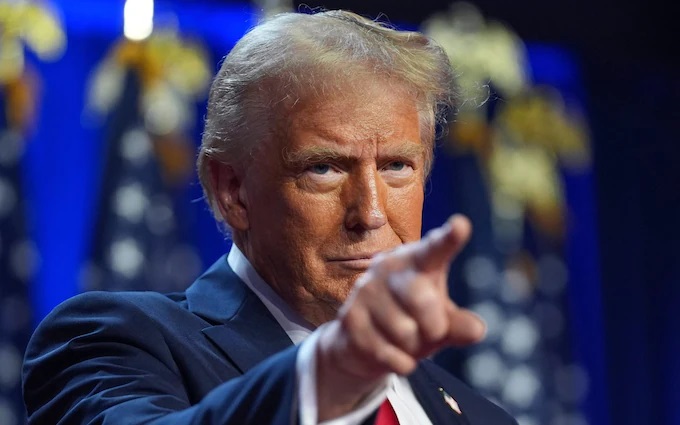
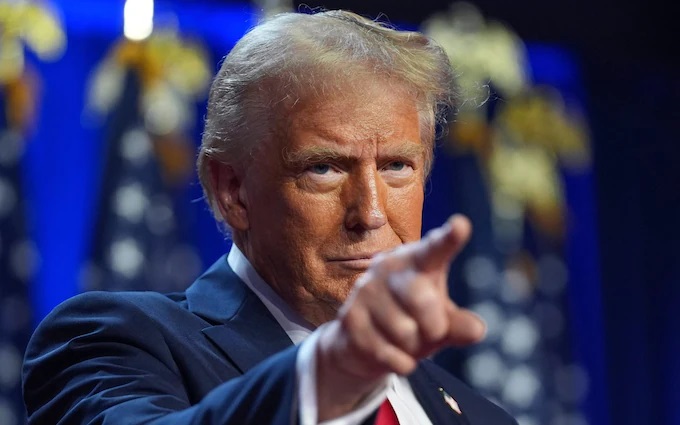
In what could be a big plus for organizers of the 2028 Los Angeles Olympics, President-elect Donald Trump is already on board with his support for the Games. He’s even gone so far to take credit for bringing the Olympics to LA.
“As President-Elect, I worked with the Olympic Organizing Committee of Los Angeles in getting the 2028 Olympics to come to the United States. There was tremendous competition from other countries,” Trump wrote in an August post on the Truth Social website. He repeated the claim in a podcast in the past month hosted by Bill Belichik, adding the 2026 World Cup as another event he purports to have secured for the U.S.
The support of the U.S. president is needed for the multiple federal agencies involved with the staging of the Olympics. Security may be the biggest ticket, along with other services ranging from diplomatic functions to weather forecasting.
But the real plum for a U.S. president is the ceremonial role played during the opening ceremony of the Games. As head of state in 2028, his last year in office, Trump will stand at the microphone in SoFi Stadium to declare the opening of the third Summer Games in Los Angeles.
Trump, as it turns out, will play a key role for the 2028 Olympics that no other U.S. President has played. He’ll have overseen the federal government involvement in Los Angeles from the days of the bid eight years ago to the opening of the Games in less than four years. Due to the timing of U.S. elections and the placement of the Olympics, such a coincidence will continue to be rare.
While this latest campaign to bring the Olympics back to Southern California began as a bid for 2024 in the last days of the Barack Obama presidency, it was the first Trump administration that organized the federal support. Then, in 2017, the IOC orchestrated the twin awarding of the 2024 Games to Paris and 2028 to Los Angeles. Included in those machinations was the need to secure the backing of the federal government prior to the IOC vote.
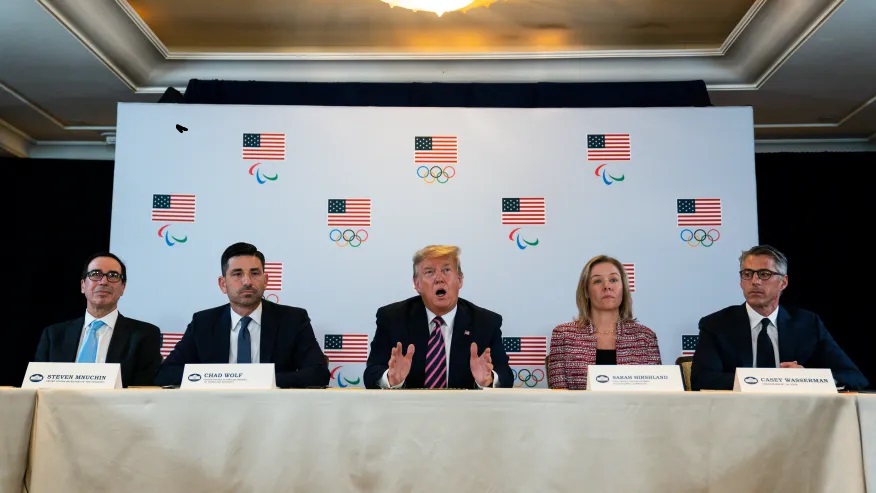
Trump signed the pledge for federal government support for the new dates for the games at a ceremony in Los Angeles in February 2020. Trump was in the final year of his first term, self-assured that he would win the election that year for a second term. Trump teased LA28 chair Casey Wasserman that he would need help with seats at the Games since Trump wasn’t expecting to be in office in 2028.
President Trump at the signing ceremony in February 2020 for the federal guarantees for the 2028 Olympics.
“I hope you remember me in 2028. Okay? Do you promise, Casey? Or will you … ”
“I promise, sir,” replied Wasserman.
“At least give me a seat, okay?” Trump responded.
“Guaranteed,” Wasserman promised.
As it turned out, Trump lost his 2020 re-election bid. But storming back into power following the results of the Nov. 5 vote, Trump can now expect great seats in Los Angeles and the opportunity to open the Games for a worldwide audience. While the head of state remarks are prescribed in the Olympic Charter, that didn’t stop the last U.S. President to open an Olympics from embellishing the script at the 2002 Winter Games in Salt Lake City. Speaking just five months after the 9/11 attacks, George W. Bush inserted a few extra words.
“On behalf of a proud, determined, and grateful nation, I declare open the Games of Salt Lake City, celebrating the Olympic Winter Games,” he proclaimed. While he varied from the protocol, the IOC did not complain.
Given his speechmaking notoriety, there’s no telling what President Donald Trump might say when his microphone opens the evening of July 14, 2028, at SoFi Stadium in Los Angeles.